The Paradigm Shift: Buy vs. Build — I Built OKRsMatter in One Workday (So We Could Skip the SaaS)
Why I chose build over buy: OKRsMatter in one workday, skipping the SaaS, and what that shift says about how teams should roll out software.

I thought I was just building a tiny OKR app.
Then I slept on it.
And I realized this wasn’t really about OKRs at all.
It was about a bigger shift in how we procure software, and how we roll it out inside companies.
So here’s the story, coffee-style. No polish. Just the insight.
The moment that sparked it
I was talking with a few Chiefs of Staff and ops leads about goal tracking.
Same question I hear all the time: “What’s the best software for OKRs?”
The answers were expected: Lattice, WorkBoard, a few other names.
But then the room got honest.
Everyone admitted the same thing:
The best tool they had ever used for OKRs was a Google Sheet.
Not because it was perfect.
But because it was easy.
No procurement. No training. No new login. No rollout plan.
Just share the sheet and go.
And that was the insight: the “best” tool isn’t the one with the most features — it’s the one people actually adopt.
The old way we buy software
If you’ve ever been in procurement or ops, you know the dance.
It usually looks like this:
- Someone raises a problem.
- You research options (G2, referrals, your network).
- You shortlist vendors.
- You book discovery calls, demos, follow-ups.
- You run a review, security, budget, and approvals process.
- Weeks (sometimes months) go by before anyone sees value.
Even if each vendor only costs five hours of attention across your team, multiply that by three vendors and you’re at fifteen hours of pure evaluation time.
That’s before you consider legal review, budgeting cycles, and internal training.
The shift
I wanted the outcomes of a SaaS tool, without the heavy process.
I wanted it to feel as easy as sharing a Google Sheet.
So I built OKRsMatter.
It was a small internal web app on top of tools we already pay for (Google Workspace).
Total focused build time was about two hours, split across the day.
The goal wasn’t to show off a fancy build. The goal was to remove a heavy admin problem without adding another vendor.
What I built (in plain English)
This is a lightweight OKR system that sits on top of a Google Sheet.
What it does:
- Create and manage company, team, and individual OKRs
- Track progress with lightweight check-ins
- Roll up results so leaders can see health at a glance
- Keep the UI simple so it actually gets used
What it doesn’t do:
- Enterprise-grade workflows
- Endless customization
- Yet another login or contract
Simple stack: Google Apps Script web app + Google Sheets as the database.
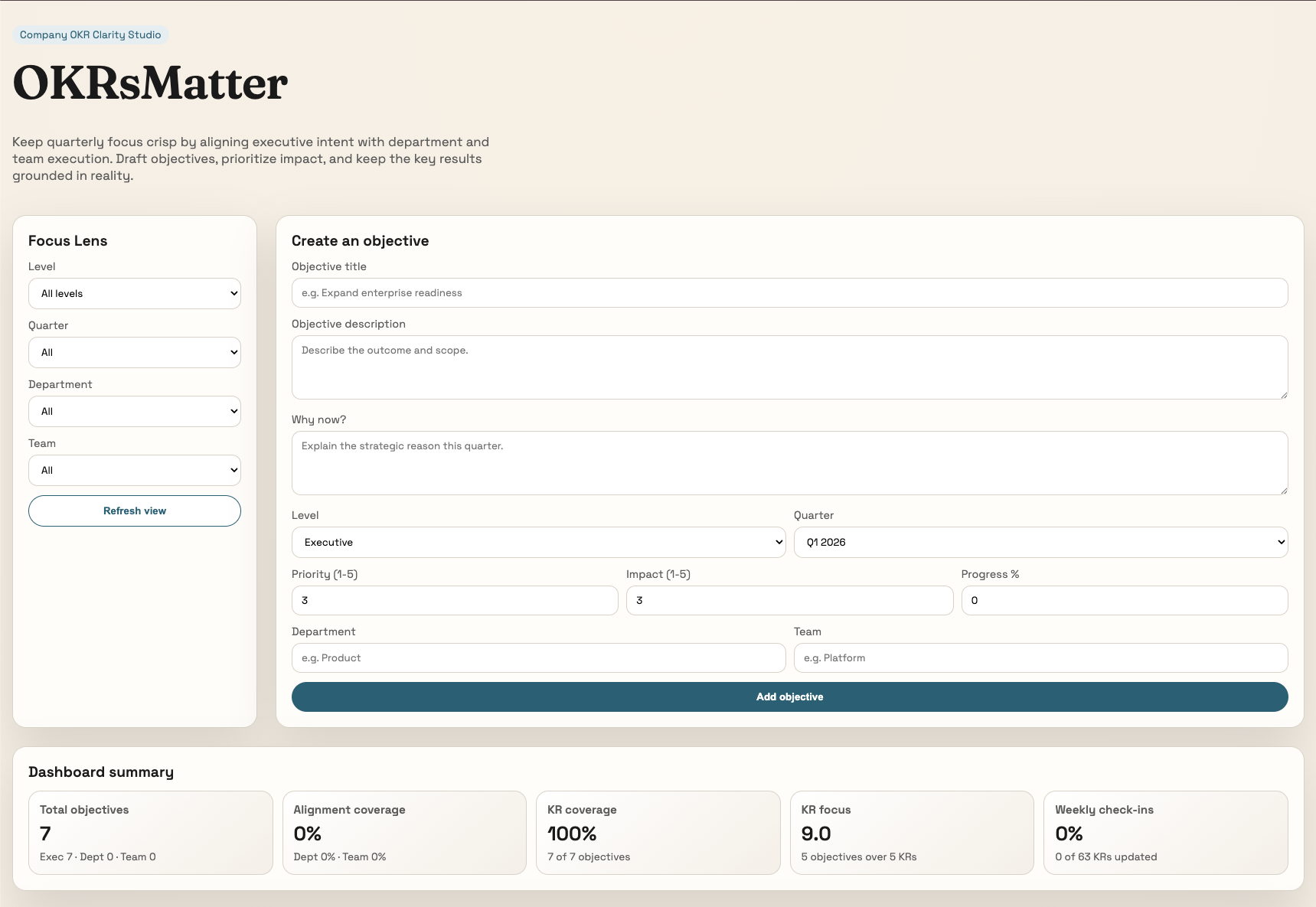
Repo: OKRsMatter is open-source → https://github.com/nmayalais/OKRsMatter
Optional AI coach (only if you want it)
I added an AI coach layer that helps people:
- Draft better objectives
- Turn vague goals into measurable key results
- Suggest next steps when progress stalls
It’s off by default. If you turn it on (Anthropic or OpenAI), it only costs money when someone uses it.
No monthly seat fees. Just usage-based costs.
Two audiences, two takeaways
I realized this post is really for two groups of people.
1) The people who buy and roll out software
If you’re in procurement, ops, or IT leadership, here’s the shift:
You don’t always need a vendor to get the outcome.
Sometimes the fastest, lowest-cost, highest-adoption option is a lightweight internal build that sits on top of tools your company already pays for.
It doesn’t replace enterprise software. But it does replace a lot of “we need another SaaS tool” moments.
If a workflow is simple and internal — OKRs, check-ins, lightweight dashboards — you can often get 80% of the value in a day.
2) The people who own goals and outcomes
If you’re a Chief of Staff, ops lead, or team manager trying to keep OKRs alive, here’s the core truth:
People don’t avoid OKRs because they hate goals. They avoid OKRs because the process is annoying.
The easiest system wins. Every time.
So if you’re stuck, try this:
- Start with a Google Sheet (because adoption matters most).
- Identify the 2-3 pain points people complain about.
- Build or commission a tiny layer that removes those pain points.
That’s it. The moment the admin overhead drops, the culture actually has room to breathe.
The bigger takeaway
When a problem feels overbearing, the instinct is to buy your way out.
But many workflows can be solved with a quick, lightweight build that:
- Feels better than a messy spreadsheet
- Avoids vendor bloat
- Costs almost nothing beyond tools you already pay for
This took one workday and a few hours of focused attention. The tradeoff is dramatically lower cost, less admin burden, and more control.
Sometimes the fastest path forward isn’t a new tool — it’s a small, purpose-built one.
Keep Reading

ChargeMatter: From $7 POC to production — and why build still beat buy
The full story: a weekend build that worked, what it actually cost to harden for production, and an honest buy vs. build analysis.

The Next 50 Years of Manufacturing Starts Now
The inflection point is here. The evidence is at every major expo. The question is whether you'll lead from the front — or become the Blockbuster of your industry.

If This Is Not On Your 2026 Roadmap, You Are Already Behind
2025 made one thing painfully clear for manufacturing leaders. This is no longer about experimenting with automation. It is about survival.